

Our approach
Your nervous system connects everything. We help you support it.
Gentle, specific care focused on you, your comfort, and how your body moves.
Understanding your nervous system
Your nervous system is your body's communication network. Your brain sends and receives messages through your spinal cord and nerves. Those messages help guide how you move, sleep, digest, grow, and respond to stress.
Your spine plays an important role in this network. The spine is made up of bones called vertebrae that protect the spinal cord, and nerves branch out through small openings between them. Chiropractors use the term subluxation to describe a vertebra that is stuck or not moving as well as it should, which may interfere with how your nervous system functions.
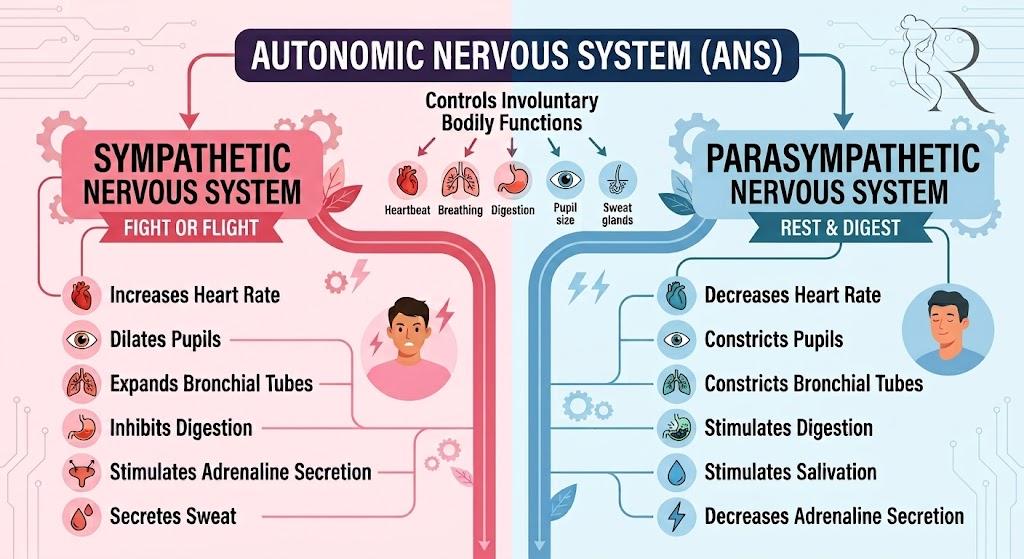
An important part of your nervous system is the autonomic nervous system, which functions unconsciously. It helps manage things you don't think about, like heart rate, breathing, and digestion. It also helps your body shift between "fight or flight" mode and "rest and digest" mode. Stress, sleep, and how well your body moves can all affect how smoothly it regulates these unconscious processes.
Chiropractic adjustments are how chiropractors address subluxations. Adjustments are gentle, specific movements applied to areas of the spine that aren't moving as well as they could. They are designed to support nervous system function and your body's natural ability to adapt and regulate.
Our focus is on supporting how your body functions. We don't diagnose or treat disease, and we'll always tell you honestly what we can and can't help with.
The autonomic nervous system at a glance
The autonomic nervous system runs the body functions you never think about — and it has two main branches that balance each other.
Frequently Asked Questions
What does 'nervous system based' chiropractic actually mean?
It means care is aimed at how your brain and body communicate, not only at where it hurts. The exam looks for areas of tension and restriction that keep the nervous system in a guarded, stressed state, and adjustments are chosen to help it settle.
Is this different from a regular chiropractic adjustment?
The adjustment itself is often gentler and more specific. The bigger difference is the lens: we ask how the whole system is regulating — sleep, digestion, mood, development — rather than only how one joint moves.
How long does it take to notice a change?
It varies by person, age, and how long the pattern has been in place. Some people notice a shift in sleep or tension within a few visits; longstanding patterns generally take longer. We reassess regularly and tell you honestly what we see.